
The Unstable Foundation: A Costly Sinking Feeling
Imagine a critical access road leading to a new industrial facility. It was constructed on weak, compressible soil, and within a year, significant ruts have appeared, causing costly delays and safety concerns. Traditionally, the solution would be extensive and expensive: excavate meters of poor soil and replace it with thousands of tons of quarried aggregate. This process is not only slow and disruptive but also environmentally taxing. Consequently, projects face blown budgets, extended timelines, and the persistent risk of future settlement. Fundamentally, the problem is that soil is strong in compression but weak in tension. It can bear vertical loads but falls apart under lateral stress. Therefore, when standard soil is used under roads, slopes, or retaining walls, it lacks the internal tensile strength to distribute pressure effectively, leading to failure. The core is building on ground that cannot support the demands placed upon it.
The Engineered Solution: A Synthetic Skeleton for the Soil
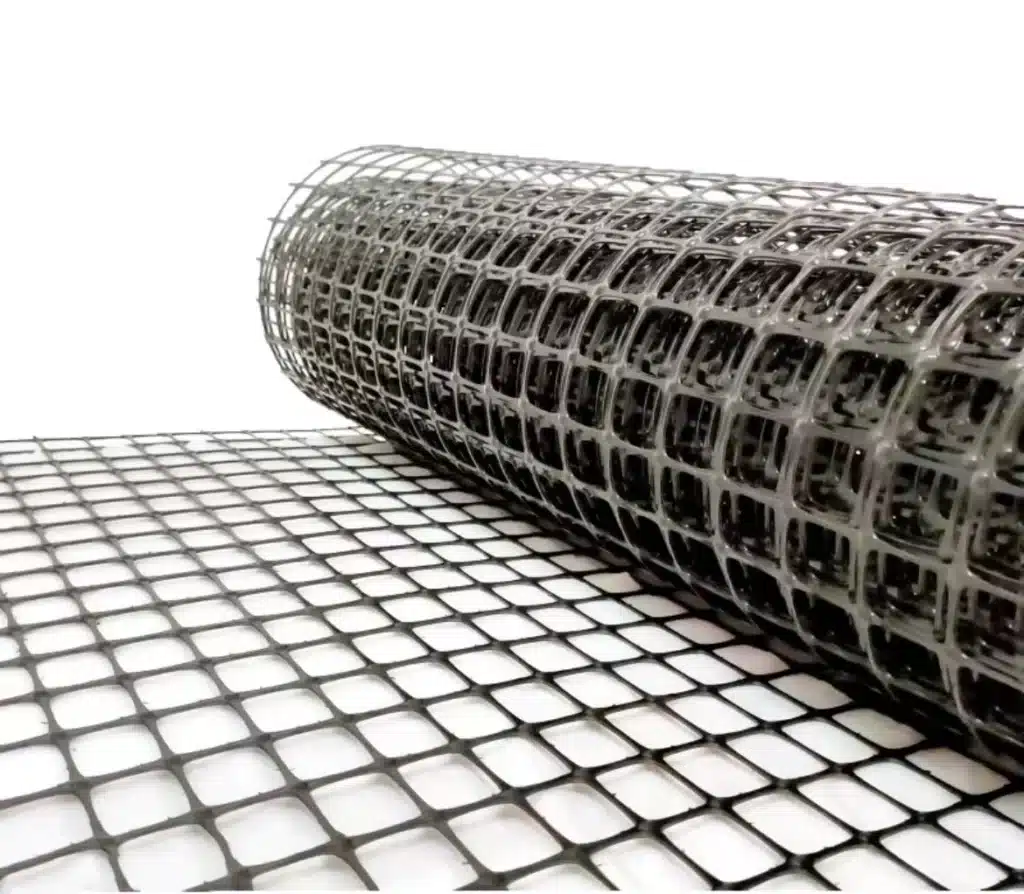
Fortunately, a revolutionary solution has transformed geotechnical engineering: the geogrid. Think of it as a high-strength polymer grid that acts as a synthetic skeleton within the soil. Essentially, when layers of geogrid are placed in the soil, they interlock with the aggregate particles, creating a mechanically stabilized composite material. This integration provides three key functions: separation (preventing the mixing of subsoil and base aggregate), reinforcement (adding tensile strength to the soil mass), and confinement (distributing loads over a wider area). As a result, the soil gains the ability to withstand forces it could never handle alone. The advantages over traditional methods are profound:
- Increased Bearing Capacity: Geogrids can increase the load-bearing capacity of soft soils by over 300%.
- Reduced Material Use: They drastically reduce the required depth of expensive imported aggregate, often by 30-50%.
- Enhanced Longevity: Reinforced structures exhibit significantly less deformation and longer service life.
The following table contrasts the two main types of geogrids and their primary applications.
Table 1: Uniaxial vs. Biaxial Geogrids – Function and Application
| Característica | Uniaxial Geogrid | Geomalla biaxial |
|---|---|---|
| Resistencia a la tracción | Very high strength in one primary direction. | High strength in two perpendicular directions. |
| Función principal | Reinforcing steep slopes and retaining walls. | Stabilizing base layers over weak subgrades. |
| Aplicaciones típicas | Reinforced soil walls, embankments, slope repair. | Roadways, parking lots, railway foundations. |
| Material | Typically Polyethylene (HDPE) or Polyester (PET). | Typically Polypropylene (PP) or Polyethylene. |
Case Evidence: Building Confidence with Proven Performance
Theoretical benefits are compelling; however, real-world evidence is what builds engineering confidence. Let’s examine a case where a geogrid provided an elegant and cost-effective solution.
Case Study: The Saturated Access Road
A logistics company needed to build a heavy-haul access road across a section of soft, clay-rich soil that became saturated and weak during the rainy season. Previous attempts with only gravel had failed repeatedly.
- Proyecto: Heavy-Haul Access Road on Soft Clay Subgrade.
- Desafío: Construct a stable road capable of supporting 100-ton vehicles without excessive long-term settlement or costly deep excavation.
- Solución: Engineers designed a reinforced section using a biaxial polypropylene geogrid. The construction sequence was:
- First, the weak topsoil was lightly graded.
- Then, a layer of biaxial geogrid was rolled out directly on the subgrade.
- Finally, a reduced thickness of compacted aggregate base course was placed on top.
- Resultado: The geogrid confined the aggregate and distributed the vehicle loads laterally, preventing the soft clay from failing. The road has performed flawlessly for over five years with minimal maintenance, saving the company over 40% in initial construction costs compared to a full-depth excavation solution.
The performance of a geogrid is quantified by its tensile strength. The following chart illustrates the critical difference between short-term and long-term design strength, a key parameter for engineers.
Chart: Geogrid Strength – Short-Term vs. Long-Term (Creep Reduction)
(A chart would show two curves. The X-axis is “Time” (log scale from 1 hour to 100 years). The Y-axis is “Tensile Strength (kN/m)”. A dotted line labeled “Short-Term Ultimate Strength” would be high and flat. A solid line labeled “Long-Term Design Strength” would start lower and decrease gradually over time, demonstrating the strength reduction due to material creep. The large gap between the lines highlights the importance of using conservative, long-term design values.)
- Short-Term Ultimate Strength: The maximum load measured in a rapid laboratory test. This value is not safe for design.
- Long-Term Design Strength: The reduced, safe load the geogrid can carry for 120 years without significant creep. This is the value used by engineers for safe design.
The Enterprise Value: Building More with Less
Choosing to integrate geogrids is a strategic decision that delivers tangible value beyond the project site.
- Risk Mitigation: By fundamentally improving the structural integrity of soil, geogrids drastically reduce the long-term risk of settlement and failure. Thus, they protect the asset’s value and minimize future liability.
- Financial Efficiency: The reduction in aggregate volume and excavation requirements translates directly into lower material and transportation costs. Furthermore, faster installation leads to earlier project completion and return on investment.
- Sustainability Leadership: Geogrids significantly reduce the carbon footprint of a project by minimizing quarrying and trucking. Therefore, their use aligns with ESG goals and promotes sustainable construction practices.
- Flexibilidad de diseño: Geogrids enable construction on sites previously deemed unsuitable. Ultimately, this opens up new possibilities for development in challenging environments.
In conclusion, the geogrid is a foundational technology that has redefined what is possible in geotechnical engineering. It provides an elegant, data-driven solution to the age-old problem of unstable ground. By choosing geogrids, engineers and developers are not just purchasing a product; they are investing in certainty, efficiency, and the long-term resilience of our infrastructure.
🌐 Página web: www.hyhdpemembrane.com


 English
  Español de México
  Português do Brasil
  Русский
  Türkçe
  Bahasa Indonesia