
Heavy-Duty 2.0mm Rough Geomembrane | Slope Stability Solution
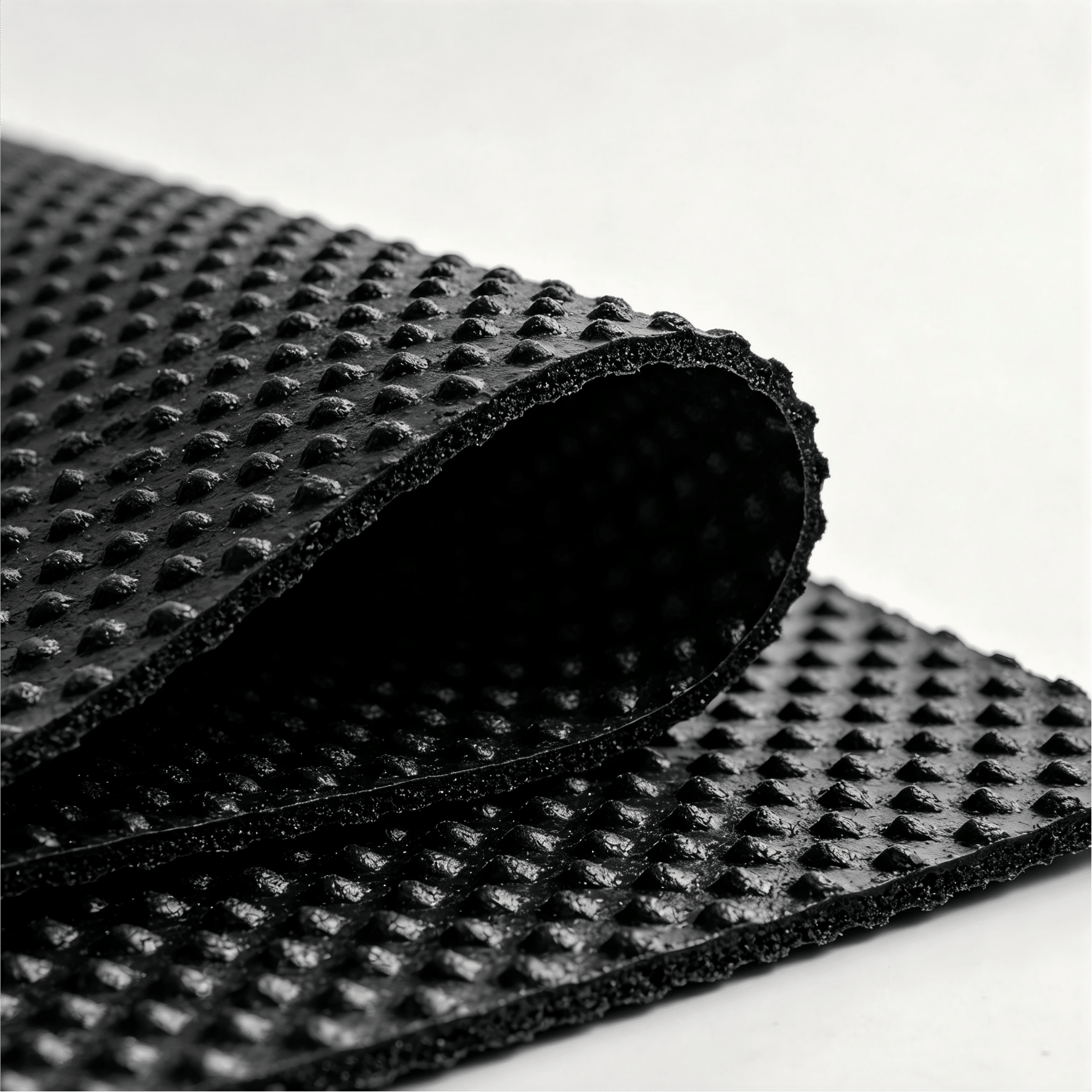
As a core material in infrastructure construction and environmental protection anti-seepage projects, geomembranes find wide application in multiple fields such as garbage landfills, water conservancy and hydropower, mining heap leaching, and municipal engineering, thanks to their excellent water-proof and anti-seepage performance. The 2.0mm rough-surface geomembrane, an upgraded product in the geomembrane family, retains the core anti-seepage function of traditional geomembranes.
Поделиться:
Описание
I. Core Characteristics of 2.0mm Rough Geomembrane
(1) Excellent Anti-slip Performance
This is the most prominent core feature of the rough geomembrane. Its surface rough texture greatly improves the interface friction coefficient. The friction angle can reach 18°~35°. It is more than 50% higher than traditional smooth geomembranes.
(2) High Strength and Anti-damage Ability
The 2.0mm thickness balances light weight and mechanical strength. All mechanical indicators are better than traditional smooth geomembranes of the same thickness. The membrane has excellent toughness.
(3) Efficient and Stable Anti-seepage Performance
Virgin HDPE raw materials have excellent barrier properties. Precise production technology further improves the anti-seepage effect. The permeability coefficient of the 2.0mm rough geomembrane is less than 10⁻¹⁷cm/s. This indicator far exceeds the basic standard of traditional geomembranes.
(4) Good Construction Adaptability
The membrane width can be customized to 6~8m. The length ranges from 50~100m. This greatly reduces the number of welding seams during construction. Fewer seams mean lower risk of seam leakage. It uses hot welding machine for double-seam connection.
(5) Long-term Weather Resistance and Corrosion Resistance
The carbon black component in the raw material can resist UV aging. Tests show that the OIT retention rate is not less than 50% after 1600h of UV irradiation. The OIT retention rate is not less than 55% after 90 days of thermal aging at 85℃. It also has excellent chemical corrosion resistance.
II. Core Gaps
Traditional geomembranes mainly include smooth HDPE, PVC and ordinary PE geomembranes. Their thickness is mostly 1.0~1.5mm. They have obvious gaps with 2.0mm rough geomembranes. The gaps cover surface structure, mechanical performance and other aspects. The specific comparison is divided into the following 6 dimensions:
(1) Gaps in Surface Structure and Anti-slip Performance
Most traditional geomembranes have a smooth surface. Their interface friction angle is only 11°~15°. The friction coefficient is low. They are easy to slide when laid on slopes exceeding 15°. They need additional fixing devices such as anchor rods and pressing strips.
(2) Gaps in Mechanical Performance and Durability
Take the 1.5mm smooth HDPE traditional geomembrane as an example. Its tensile yield strength is about 22N/mm. Its puncture resistance is about 400N. The 2.0mm rough geomembrane has a tensile yield strength of 29N/mm. Its puncture resistance reaches 535N. Its mechanical performance is improved by more than 30%. Traditional geomembranes are relatively thin. They are easy to damage during construction, settlement or impact.
(3) Gaps in Anti-seepage Performance and Stability
Traditional geomembranes have basic anti-seepage functions but unstable performance. Some products use recycled raw materials. Their production process is simple. The smooth surface leads to poor bonding with the base surface. It is easy to form “hollows”. This will produce local anti-seepage weak points. The 2.0mm rough geomembrane uses virgin HDPE raw materials. Its thickness is uniform. Its permeability coefficient is stably below 10⁻¹⁷cm/s. It has higher bonding degree. The small gap layer can buffer the stress from base surface deformation. It ensures stable anti-seepage.
(4) Gaps in Construction Efficiency and Cost
Traditional geomembranes have a width of 4~6m and a short length. They have many seams during construction. The welding workload is large and efficiency is low. More seams also increase the risk of leakage. They also need additional fixing devices. This increases construction procedures and material costs. The 2.0mm rough geomembrane can reach a width of 8m. Its maximum length is 100m. The number of seams is reduced by more than 30% compared with traditional geomembranes. Welding efficiency is improved. It does not need additional fixing. It simplifies construction procedures. Although its per square meter cost is 10%~25% higher, its comprehensive cost performance is better.
(5) Gaps in Application Adaptability
Traditional geomembranes have poor anti-slip performance and insufficient strength. Their applicable scenarios are limited. They are mainly used for ordinary projects with slopes ≤15° and no complex deformation. Such projects include small reservoirs and farmland irrigation channels. The 2.0mm rough geomembrane has good anti-slip performance, high strength and strong stability.
(6) Gaps in Production Technology and Raw Materials
Traditional geomembranes mostly adopt a single extrusion process. Some manufacturers use recycled PE raw materials. Their product performance is unstable. They are prone to aging, damage and other problems. Their quality is difficult to guarantee. The 2.0mm rough geomembrane adopts advanced co-extrusion blow molding technology.
III. Summary
Похожие товары
-
Серия геомембран
Геомембрана HDPE 1,0 мм для облицовки прудов
-
Серия геомембран
Высококачественная и прочная геомембрана для различных месторождений
-
Серия геомембран
Текстурированная геомембрана из ПНД


 English
  Español de México
  Português do Brasil
  Русский
  Türkçe
  Bahasa Indonesia